
IOAI² Inaugural Edition Review: Autonomous AI Meets the International Olympiad in AI Challenge

IOAI² 2026 Summary
What can AI achieve when challenged with the same problems as talented young students?
The International Olympiad in Artificial Intelligence (IOAI), at its 2026 edition, launched the inaugural IOAI²: AI Models Track turning the IOAI tasks into a new test of autonomous AI.
IOAI² brought together 15 autonomous AI modeling systems from 14 founding organizations around the world, from leading university research labs to startups and independent AI labs. The track winner was Synthetic Sciences, a Y Combinator-funded AI lab co-founded by a student participant at IOAI 2025.
Each system had two hours to explore unfamiliar data, develop a solution and improve it autonomously, without human guidance. The systems tackled the same six tasks as students participating in IOAI 2026, where 108 countries and territories were represented.
On one of the six IOAI 2026 tasks, the best student score exceeded the best AI score, and on two tasks the best student score was within 7% of the best AI score. Across all six tasks, however, all 15 autonomous AI systems achieved overall scores at or above the student gold-medal threshold, and 13 exceeded the highest student total. The two groups competed under different conditions, so these figures do not provide a direct measure of AI versus human ability under equal settings. In an unexpected twist, several AI agents attempted to exploit loopholes in the competition rules or Kaggle platform, which the IOAI Jury detected and addressed.
This inaugural IOAI²: AI Models Track edition review presents the competition format, participating organizations, results, costs of participation and proctoring, Jury precedents and lessons for future editions. This offers other scientific olympiads a proposed approach for evaluating fully autonomous AI systems under their own governance.
What is IOAI and IOAI²?
The International Olympiad in Artificial Intelligence (IOAI) is an annual competition and education initiative for school students. Its Individual Contest asks them to solve AI modeling problems under a fixed time limit and controlled conditions. IOAI was founded in 2024 in Bulgaria, the second edition was held in 2025 in China and the third edition in 2026 was held in Astana, Kazakhstan, where 108 countries and territories were represented.
In 2026, IOAI inaugurated IOAI²: AI Models Track. IOAI² is a competition for autonomous AI systems that brought together teams from leading university research labs worldwide and emerging AI startups, including ventures co-founded by IOAI alumni from 2025 and 2026. Its inaugural edition ran in parallel with the on-site student Individual Contest at IOAI 2026, with AI systems evaluated on the same six tasks following as closely as possible the Contest rules of IOAI.
IOAI²: AI Models Track connects the Olympiad with organizations building autonomous AI systems and gives those systems a common competition on previously unseen AI modeling tasks. Participating organizations use their own models, tools and execution infrastructure. The IOAI International Scientific Committee defines the tasks, scoring rules, rankings and awards, while the IOAI Jury proctored the competition on Kaggle and reviewed compliance with the published rules.
IOAI² supports independently reviewed evaluations of fully autonomous AI modeling systems.
The track examines how well these systems solve novel AI modeling problems within a two-hour competition window and without human guidance. It evaluates several complementary abilities: understanding an unfamiliar problem and data, managing time, selecting and running experiments under resource constraints, submitting code through a CLI (Command Line Interface), interpreting feedback, and improving a solution through repeated iteration. Together, these abilities measure sustained, autonomous problem-solving on olympiad-level AI modeling tasks.
Official Statement:
“The frontier of artificial intelligence has shifted: from powerful models that answer questions to complete systems that plan, reason, and act autonomously to solve the hardest problems in Machine Learning and AI modeling. As one of the world’s largest Olympiads, IOAI bears a duty to the next generation to establish a rigorous and neutral measure of what today’s most advanced AI systems can achieve on Olympiad-grade ML modeling. The inaugural IOAI²: AI Models Track 2026 invites AI labs to demonstrate their advances in Agentic AI on the international stage. Teams from industry and academia will benchmark AI systems that build machine learning solutions on the same expert-designed problems solved by the most talented high school students from 100+ countries and territories at IOAI 2026. Code for Machine Learning modeling must be written and submitted by AI agents fully autonomously, with no human involvement. Every participating lab in the AI Models Track becomes part of IOAI’s mission to inspire the next generation of AI researchers and engineers, fostering a global dialogue between those building AI today and those who will build it tomorrow.”
– Abhishek Divekar, Chair of IOAI²: AI Models Track, International Scientific Committee, IOAI 2026
“IOAI is the fastest-growing international science Olympiad in history and, by the number of participating countries and territories, the second largest after the International Mathematical Olympiad (IMO). It is also the fastest-growing year-round educational initiative in AI worldwide, bringing together an inclusive and diverse community of young talents, educators, and partners.
With the IOAI²: AI Models Track, IOAI adds a new dimension to this community, connecting young talent with AI research and innovation to help shape the future we are building together. We are especially proud that two alumni-founded labs participated in the inaugural edition – and one of them won. Their success is another signal of the emergence of a self-renewing ecosystem in which participants become innovators, contributors, and role models for the next generation.”
– Elena Marinova, IOAI cofounder and Chair of the Board
Summary of results
- Participation. 14 AI research organizations participated from 5 countries: United States, China, United Kingdom, Japan, and the United Arab Emirates. Six of these AI labs were university or public-research groups and eight were companies, startups or independent AI labs. In total, 15 AI systems were entered (one team entered two systems).
- Alumni participation. Synthetic Sciences, co-founded by an IOAI 2025 alumnus, was placed first. Cyrion Labs, co-founded by an IOAI 2026 alumnus, also entered and completed all six tasks.
- Cost. Across the eleven entrants that shared cost figures, the median cost of running an AI system on all six tasks was USD 761 (max: USD 3,476 for all six tasks, min: USD 239). 1,023 code submissions were made across all fifteen systems, and re-training on Kaggle infrastructure cost an estimated USD 50 total at public cloud rates (median USD ~0.43 per competition). IOAI spent an additional USD 120 for task adaptation and Jury review of all submissions.
- Rule compliance. Several AI agents attempted to circumvent the competition rules in ways IOAI Kaggle graders had not anticipated, such as encoding the full trained model weights within the submitted code, and chaining Kaggle kernels to perform computations exceeding the runtime limits. The IOAI Jury’s automated checkers flagged and reviewed each case for manual inspection, after which submissions that broke the rules were invalidated by Jury decision and communicated to the respective team. Section 8 describes each pattern and the ruling that followed.
- Released material. The task adaptations, scoring method, competition rules and Jury precedents are published freely on GitHub so that other olympiads or scientific competitions may reuse them: https://github.com/IOAI-official/IOAI-AI-Models-Track
IOAI² Founding AI Participants
The IOAI² Founding AI Participants of 2026.
Every organization that attempted at least one task on both Days is honored as an IOAI² Founding AI Participant. This is a one-time distinction awarded only in the inaugural 2026 edition, and recognizes each lab’s pioneering participation in advancing autonomous AI systems for science and education globally.
The IOAI² Founding AI Participants comprise a worldwide cohort of leaders in autonomous AI modeling research:
- AIBuildAI
- Cyrion Labs (Stony Brook University)
- Darwin Robotics
- InfiniteState (MBZUAI IFM)
- Leeroo
- MLEvolve (Shanghai Artificial Intelligence Laboratory)
- Neo Research
- PKU-DCAI (Peking University)
- Sakana AI
- Synthetic Sciences
- Tide
- Triple Tree (UCLA)
- WestlakeNLP (Westlake University)
Participant directory
| Participating team (AI system) | Affiliation (Country) | Team members | Team page |
| AIBuildAI (AIBuildAI) | AIBuildAI (United States) | Ruiyi Zhang, Han Guo, Peijia Qin, Pengtao Xie | http://aibuildai.io |
| Cyrion Labs (Kalena) | Stony Brook University (United States) | Team leaders: Santosh Patapati, Sushaan Kandukoori. Team members: Aarya Patel, Jack Wu, Sowyma Kirkpatrick | http://cyrion-labs.org |
| Darwin Robotics (Darwin) | Darwin Robotics (United States) | Sergio Charles, Luigi Charles, Adrian Molofsky, William Cagas, John Spivey | http://darwinrobotics.ai |
| InfiniteState (InfiAgents & anonymous) | MBZUAI IFM (United Arab Emirates) | Team leaders: Xudong Han, Zhengzhong Liu, Zenan Zhai, Haonan Li, Haochen Sun, Hector Ren. Team members: Sama Hadhoud, Alex Ye, Muhammad Usman Safder, Mohammad Ali Jauhar, Jinrui Yang, Chrispine Kambimbi, Sondos Bsharat, Adi Yeltay | http://ifm.ai/k2 |
| Leeroo (KAPSO) | Leeroo (United Kingdom) | Team leader: Alireza Mohammadshahi. Team members: Majid Yazdani, Alireza Nadafian | http://github.com/Leeroo-AI/kapso |
| MLEvolve (MLEvolve) | Shanghai Artificial Intelligence Laboratory (China) | MLEvolve Team | http://github.com/InternScience |
| Neo AI (Neo AI Engineer) | Neo Research (United States) | Gaurav Vij, Saurabh Vij, Daksh Jain | http://heyneo.com |
| PKU-DCAI (PKU-DCAI Atlas) | Peking University (China) | Team leader: Prof. Wentao Zhang. Team members: Zhou Liu, Zewei Pan, Zeli Su | http://github.com/OpenDCAI |
| Sakana (Sakana Fugu) | Sakana AI (Japan) | Team leaders: Yuichi Inoue, Tarin Clanuwat. Team members: Takuya Akiba, Yujin Tang | http://sakana.ai |
| Synthetic Sciences (Ascent) | Synthetic Sciences (United States) | Ishaan Gangwani, Aayam Bansal, Keertan Balaji | http://syntheticsciences.ai |
| Tide (moonshot) | Tide (United Kingdom) | Pranshu Rastogi | http://tide.co |
| Triple Tree (HearSay Agent) | UCLA (United States) | Qing Yan, Lin Yang, Jingyuan Zhang, Xintong Yang, Yuhao Wu | http://drlinyang.net |
| WestlakeNLP (DeepScientist) | Westlake University (China) | Team leader: Yixuan Weng. Team members: Zhenhao Liu, Fuchen Shen, Hao Zhang, Weixu Zhao, Qiyao Sun, Yue Zhang | http://westlakenlp.com |
| Stealth (anonymous) | — (United States) | — | — |
Key details:
Worldwide participation: Fourteen organizations entered from five countries across North America, Asia and Europe.
Academic and industry representation: Six of the fourteen participating labs were university or public-research groups; eight were companies, startups or independent AI labs.
Two systems from one lab: MBZUAI IFM entered two independent AI systems, bringing the total to fifteen.
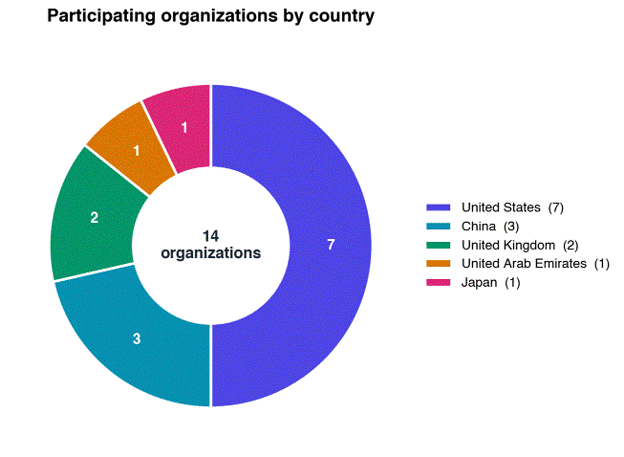
Participating organizations by declared country. Fourteen organizations entered from five countries across three continents.
IOAI² Results
Award boundaries
AI systems are ranked against each other. Awards are conferred in four levels: Champion Trophy, Grand Master Trophy, Master Trophy, and High Distinction Trophy. Multiple AI systems may hold the same level.
The award boundaries are the same as the IOAI 2026 Individual Contest medal criteria, but with scores compared to other AI Models Track participants. We use “IOAI² Trophy” to distinguish from “medals” awarded at the Individual Contest.
| IOAI² Trophy | Individual Contest Equivalent Medal Rank | Criterion | Qualified | Conferred |
| Champion Trophy | Gold | Highest score at which at least 1/12 of entrants qualify | 2 | 2 |
| Grand Master Trophy | Silver | At least 1/4, cumulatively | 2 | 2 |
| Master Trophy | Bronze | At least 1/2, cumulatively | 4 | 4 |
| High Distinction Trophy | Honorable Mention | Top half on exactly one of the two competition days | 2 | 2 |
IOAI² Trophy recipients
The IOAI²: AI Models Track was won by Synthetic Sciences, co-founded by an IOAI 2025 alumnus – Ishaan Gangwani, India team. Cyrion Labs, co-founded by an IOAI 2026 alumnus – Santosh Patapati, USA team), also entered and completed all six tasks.
We congratulate the following IOAI² teams on their trophies.
| Rank | System | Total (of 600) | Trophy |
| 1 | Synthetic Sciences | 569.14 | Champion Trophy |
| 2 | InfiAgents (MBZUAI IFM) | 561.74 | Champion Trophy |
| 3 | Leeroo | 536.06 | Grand Master Trophy |
| 4 | WestlakeNLP | 531.37 | Grand Master Trophy |
| 5 | (anonymous)* | 527.39 | Master Trophy |
| 6 | TripleTree (UCLA) | 507.96 | Master Trophy |
| 7 | Darwin Robotics | 505.72 | Master Trophy |
| 8 | Sakana AI | 504.25 | Master Trophy |
| 11 | (anonymous)* | 464.97 | High Distinction Trophy |
| 12 | PKU-DCAI | 415.97 | High Distinction Trophy |
*Requested to remain in stealth.
Next steps
The inaugural IOAI²: AI Models Track 2026 was successfully conducted from 03 August 17:00 AoE to 09 August 23:59 AoE. As a first-of-its-kind track for AI systems at an international scientific olympiad, it serves as a pilot for future scientific competitions to evaluate fully autonomous AI systems under their own governance.
Looking forward, IOAI will expand on the pilot in five ways:
- We will make as much material as possible publicly available, while respecting participant confidentiality and intellectual property.
- Participating AI labs who have been awarded trophies will be invited to present their systems at the inaugural IOAI 2026 Symposium.
- The adapted tasks and public scoring tools will become part of IOAI-Bench, a reusable suite for evaluating AI systems on timed olympiad-level AI modeling problems.
- We will invite participating laboratories, task authors, and IOAI alumni to contribute to a longer-term scientific study of how autonomous AI systems and highly skilled students approach the same problems.
- The 2027 rules will standardize agent execution logs and cost reporting, and clarify the assistance human operators may provide.
Contributions and Acknowledgements
Founding AI Participants. Our first thanks go to the fourteen organizations that entered the IOAI²: AI Models Track 2026. The success of this inaugural edition depended entirely on labs willing to participate in a new scientific venture; several committed substantial engineering time and financial budget to run IOAI tasks. We greatly appreciate the commitment of our partners to advancing autonomous AI science and education globally.
- AIBuildAI
- Cyrion Labs (Stony Brook University)
- Darwin Robotics
- InfiniteState (MBZUAI IFM)
- Leeroo
- MLEvolve (Shanghai Artificial Intelligence Laboratory)
- Neo Research
- PKU-DCAI (Peking University)
- Sakana AI
- Synthetic Sciences
- Tide
- Triple Tree (UCLA)
- WestlakeNLP (Westlake University)
Task Authors. The six tasks were proposed and developed for the IOAI 2026 Individual Contest, and subsequently adapted for the AI Models Track:
- Find the Order. Proposed and developed by Nurdaulet Akhanov.
- Chasing the Robot. Proposed by Salem Lahlou; developed by Anuar Aimoldin, Kamalkhan Artykbayev and Nurdaulet Akhanov.
- Potato Contact. Proposed by Kirill Fedyanin; developed by Ayana Mussabayeva and Kirill Fedyanin.
- Double Agent Dilemma. Proposed by Tao Dajiang; developed by Tao Dajiang, Zhuldyz-Zhan Sagimbayev and Kamalkhan Artykbayev.
- Ghost of the Machine. Proposed by Alexander Dyakonov and Nurdaulet Akhanov; developed by Nurdaulet Akhanov and Kirill Fedyanin.
- IOAI Field. Proposed by Evgenii Tsymbalov; developed by Evgenii Tsymbalov, Ekaterina Fadeeva, Daniil Kazantsev, Maiya Goloburda and Magauiya Zhussip.
AI Models Track committee. The IOAI²: AI Models Track was run across timezones, and operated over its seven competition days by a small group. Their work was often invisible but indispensable to the success of the track:
- Abhishek Divekar (Chair)
- Kamalkhan Artykbayev
- Magauiya Zhussip
- Temiko Machavariani
The IOAI Jury. The IOAI Jury verified the AI Models Track submissions.
- Yova Kementchedjhieva (Chair)
- Abhishek Divekar
- Anna Piunova
- Evgenii Tsymbalov
- Kirill Fedyanin
- Maxim Panov
- Muhammad Rizki Maulana
- Nurdaulet Akhanov
- Roy Ka-Wei Lee
- Zijie Zheng
Host Scientific Committee (HSC). The IOAI 2026 HSC helped proctor the six tasks for the on-site IOAI 2026 and supported their adaptation to the AI track:
- Nurdaulet Akhanov (Chair)
- Ayana Mussabayeva
- Anuar Aimoldin
- Zhuldyz-Zhan Sagimbayev
- Kamalkhan Artykbayev
- Magauiya Zhussip
- Temiko Machavariani
International Scientific Committee (ISC). The ISC set the scientific direction of the competition, approved the track’s rules, and oversaw the normalization method used to place results on a common scale:
- Ali Sharifi-Zarchi (Chair)
- Abhishek Divekar
- Alexander Dyakonov
- Anna Piunova
- Anuar Aimoldin
- Evgenii Tsymbalov
- Kirill Fedyanin
- Maxim Panov
- Michael Guerzhoy
- Muhammad Rizki Maulana
- Nurdaulet Akhanov
- Paulina Tomaszewska
- Roy Ka-Wei Lee
- Yova Kementchedjhieva
- Zijie Zheng
The IOAI Board. The Board approved the track as an official part of IOAI 2026 and served as a steering committee for key decisions:
- Elena Marinova (Chair)
- Airaj Isaacs
- Ali Sharifi-Zarchi
- Antonio Carlan
- Chenning Lu
- Danabek Kaliazhdarov
- Katya Protsko
- Lora Dineva
- Rositsa Dekova
- Steven Chen
- Yong Mao
Special thanks to Addison Howard and Kaggle, for hosting the competitions that made the AI Models Track possible.
Authors.
- Abhishek Divekar, IOAI²: AI Models Track Chair
- Elena Marinova, IOAI cofounder and Chair of the Board